What Are Purgatory and Indulgences?
Short Answer
Purgatory is the final purification of those who die in the friendship of God but are not yet perfectly purified for the vision of God.
It is not a second chance after death, nor is it a lesser form of Hell. Every soul in Purgatory is saved and will ultimately enter Heaven.
The reason purification may remain necessary is that the forgiveness of sin does not necessarily remove every temporal punishment or every remaining disorder caused by sin. Scripture itself gives the example of David: God forgave his sin, yet a temporal chastisement remained. The Council of Trent solemnly taught that temporal punishment may remain after the guilt and eternal punishment of sin have been forgiven.
This is why Catholics have always prayed for the faithful departed. 2 Machabees 12:43–46 explicitly records sacrifice and prayer being offered for the dead. The ancient Church continued the same practice in her Eucharistic worship. St Cyril of Jerusalem, St John Chrysostom and St Augustine all testify to prayers and offerings for departed Christians. The Councils of Florence and Trent taught that the souls being purified after death can be assisted by the Mass, prayers, almsgiving and other suffrages of the faithful.
An indulgence is not forgiveness of sin and certainly not permission to commit sin. It is the remission, before God, of temporal punishment due to sins whose guilt has already been forgiven.
The Church grants indulgences by applying the spiritual treasury entrusted to her—above all the infinitely sufficient merits of Jesus Christ. Catholic teaching distinguishes partial indulgences, which remit part of the temporal punishment, from plenary indulgences, which remit all of it when the required conditions and dispositions are fulfilled.
There were genuine historical abuses associated with indulgences. The Catholic Church did not define those abuses as doctrine. On the contrary, the Council of Trent simultaneously reaffirmed the Catholic doctrine of indulgences and ordered abuses connected with them to be abolished, including corrupt financial gain, superstition and irreverence. The existence of abuse therefore must be distinguished from the doctrine being abused.
Why This Question Matters
Purgatory and indulgences touch several fundamental questions about the Christian life:
What actually happens when God forgives us?
Does forgiveness mean that every consequence of sin simply disappears?
Must a person be perfectly holy to behold God?
Can Christians assist those who have died?
And what exactly did the medieval Church mean when she granted an indulgence?
These questions also affect how Catholics understand Confession, penance, suffering, the Mass, prayer for the dead and preparation for death.
There are two opposite errors to avoid.
The first imagines that Purgatory means Christ's sacrifice was insufficient, as though sinners somehow had to complete what Christ failed to accomplish.
The second treats forgiveness as though sin left no disorder, no need for satisfaction and no consequences once guilt had been remitted.
Catholic teaching holds neither position.
Everything that saves, forgives, purifies and satisfies derives ultimately from Jesus Christ and His Passion.
Yet Christ applies the fruits of His redemption to us in a way that truly transforms us, disciplines us and makes us holy.
Purgatory therefore concerns not a deficiency in Christ's redemption but the final application of that redemption to a soul that already belongs to Christ.
What the Catholic Church Teaches
Purgatory Is the Final Purification of the Saved
The Council of Florence (1439) taught that those who die truly repentant and in the charity of God, but before they have made full satisfaction for their sins, are purified after death and can be assisted by the prayers, Masses, alms and other works of the faithful.
The Council of Trent (1545–1563) reaffirmed that there is a Purgatory and that the souls detained there are assisted by the suffrages of the faithful, especially by the Holy Sacrifice of the Mass. At the same time, Trent expressly warned pastors against speculative curiosities, superstition and anything tending toward financial gain.
Purgatory therefore applies only to those who die in God's grace.
A person dying unrepentant in mortal sin is not purified in Purgatory and later admitted to Heaven.
Purgatory is not an opportunity after death to change one's final choice for or against God.
Nor is Purgatory a destination parallel to Heaven and Hell. It is temporary purification ordered entirely toward Heaven.
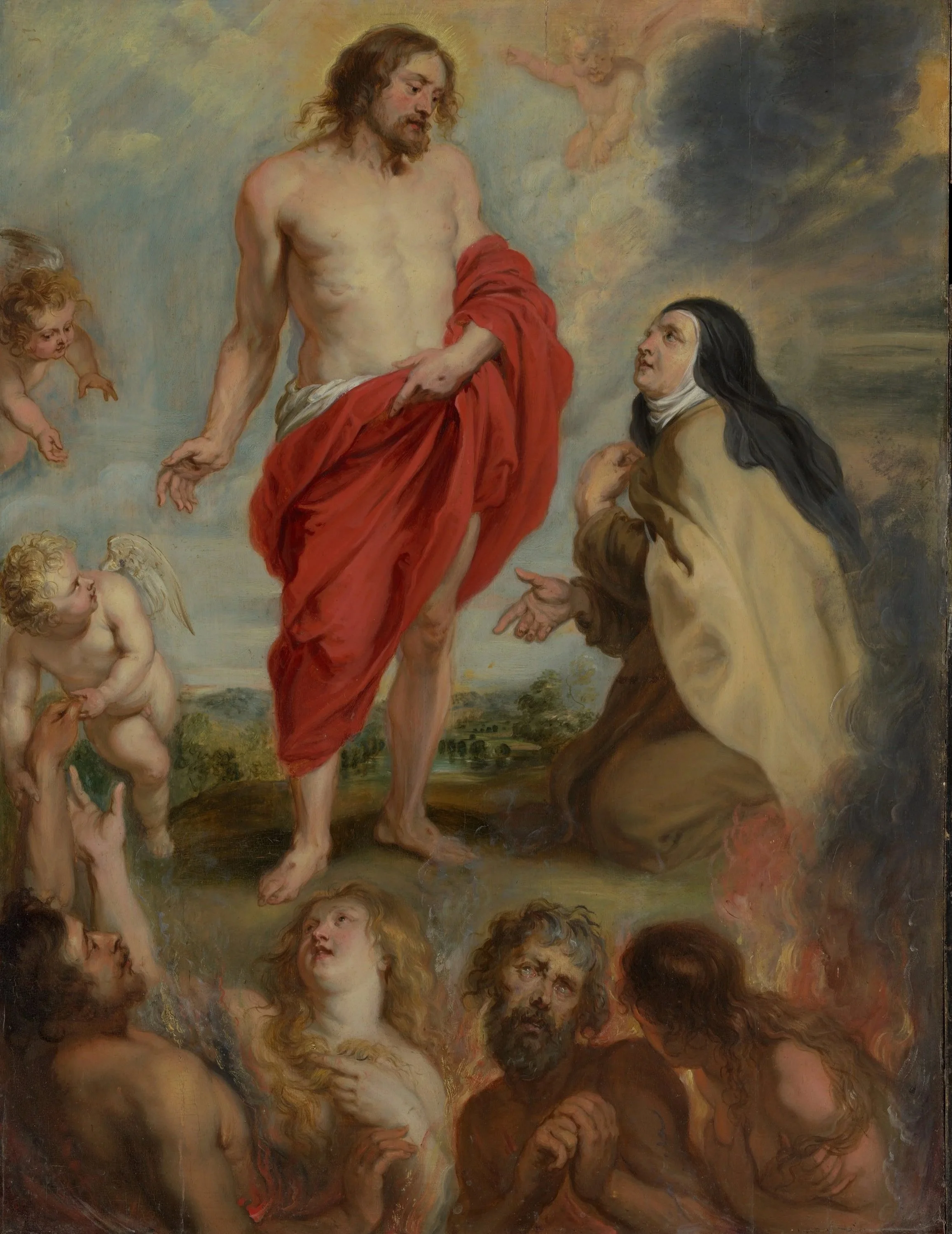
Saint Teresa of Ávila Interceding for Souls in Purgatory, workshop of Peter Paul Rubens, 17th century. St Teresa intercedes for the souls undergoing purification, who suffer temporarily while being prepared for the perfect holiness required for Heaven.
Forgiveness and Temporal Punishment Are Not the Same Thing
This distinction is indispensable. Sin can involve:
Guilt — the sinner's personal culpability before God.
Eternal punishment — the loss of God resulting from unrepented mortal sin.
Temporal punishment — a finite consequence or debt of satisfaction that may remain even when guilt has been forgiven.
The clearest biblical illustration is King David. After David's adultery and murder, he repented. Nathan told him:
“The Lord also hath taken away thy sin.”
Yet Nathan immediately announced a temporal chastisement resulting from David's sin. See 2 Kings 12:13–14—called 2 Samuel 12:13–14 in many modern Bibles.
David was forgiven, but that did not mean that every consequence of his sin disappeared.
This distinction was solemnly defended at the Council of Trent. Session VI, Canon 30 rejected the proposition that whenever guilt and eternal punishment are forgiven, no temporal punishment can remain either in this life or in Purgatory.
The point is not that God forgives incompletely. Rather, God's forgiveness can coexist with a father's correction of his child. Scripture itself says:
“Whom the Lord loveth, he chastiseth.”
See Hebrews 12:5–11.
Christ Alone Makes Satisfaction Possible
Nothing in Catholic teaching places human satisfaction alongside Christ's sacrifice as though the two were independent sources of redemption.
The Roman Catechism, explaining satisfaction in the Sacrament of Penance, teaches that Christ's satisfaction is complete and superabundant. Any satisfactory value possessed by our prayers, penances, almsgiving or patiently endured sufferings exists because of Christ and through union with His Passion.
This is the governing principle:
Christ merits everything → grace unites us to Christ → our penance receives value from Him → His redemption actually purifies and sanctifies us.
Catholic satisfaction therefore does not compete with Calvary. It is one of the ways in which the merits of Calvary are applied to members of Christ's Mystical Body.
The Biblical Foundation
A Biblical Progression Rather Than One Strict Old Testament Type
Unlike the Eucharist, which has very clear types such as manna and the Paschal lamb, Purgatory should not be forced into a single Old Testament type.
The biblical evidence is better understood as a progression of revealed principles:
| Biblical Reality | What It Shows |
|---|---|
| David is forgiven yet chastised — 2 Kings 12:13–14 | Forgiveness of guilt does not necessarily remove every temporal consequence of sin |
| Prayer and sacrifice for the dead — 2 Machabees 12:43–46 | The departed can benefit from the prayers and sacrifices of God's people |
| The saved man suffers loss “as by fire” — 1 Corinthians 3:13–15 | Scripture can speak of a person who is saved while nevertheless undergoing a painful purifying judgment |
| Holiness is necessary to see God — Hebrews 12:14 | Perfect communion with God requires holiness |
| Nothing defiled enters Heaven — Apocalypse 21:27 | The final state of the blessed admits no impurity |
| Christ gives His Church the power of binding and loosing — Matthew 16:19; 18:18 | Christ established genuine ecclesiastical authority relating to sin and its consequences |
These passages do not all teach the entire doctrine individually. Taken together and read within Apostolic Tradition, however, they establish the principles from which the Church's teaching on purification, satisfaction and suffrages becomes intelligible.
Prayer for the Dead in 2 Machabees
The most explicit biblical evidence is 2 Machabees 12:43–46.
Judas Machabeus discovered that some fallen Jewish soldiers had unlawfully kept objects associated with idols. He nevertheless collected money for a sin offering to be sent to Jerusalem and arranged sacrifice for the departed.
The sacred writer approves prayer for the dead precisely because of hope in their resurrection.
For Catholics, the passage is part of inspired Scripture. But even someone who rejects the Catholic Old Testament canon must still reckon with its historical evidence: Jews shortly before the coming of Christ were offering prayer and sacrifice on behalf of the departed.
St Thomas Aquinas later addressed the objection that these soldiers appeared to have committed idolatry. He notes possible explanations concerning their culpability and repentance rather than treating the episode as proof that the damned can be released from Hell.
The essential point of the passage remains that inspired Scripture approves intercession for the departed. (New Advent)
“Saved Yet So as by Fire”
In 1 Corinthians 3:13–15, St Paul describes a man's work being tested:
“He shall suffer loss; but he himself shall be saved, yet so as by fire.”
This text contains an important distinction:
the person concerned is saved,
yet he nevertheless experiences loss associated with God's judgment.
That is entirely compatible with Catholic teaching concerning a purifying judgment of the saved.
It is therefore useful supporting evidence but need not bear the entire weight of the doctrine. This provides clearer evidence concerning forgiveness with remaining punishment, prayer for the dead and the absolute purity required for Heaven.
“Neither in This World Nor in the World to Come”
Our Lord says in Matthew 12:32 that blasphemy against the Holy Ghost will not be forgiven “neither in this world, nor in the world to come.”
Catholic writers have seen in this wording an implication that some consequences of sin can be remitted in the world to come, although the passage is indirect evidence rather than a complete definition of Purgatory.
Nothing Defiled Can Enter Heaven
Apocalypse 21:27 says that nothing defiled shall enter the heavenly Jerusalem.
At the same time, Scripture repeatedly acknowledges that
justified Christians may die with imperfections. James 3:2 says that “in many things we all offend,” while
Hebrews 12:14 commands Christians to pursue the holiness without which no man shall see God.
The doctrine of final purification brings these truths together without denying either one:
a soul may die truly belonging to Christ → yet not be perfectly purified → nothing imperfect enters the vision of God → therefore God completes the soul's purification.
The Early Church Prayed for the Dead
The practice was not invented in the Middle Ages.
St Cyril of Jerusalem
St Cyril of Jerusalem (c. AD 313–386), in his Mystagogical Catecheses, delivered about AD 350, explains the Eucharistic commemoration of departed Christians. After recalling patriarchs, prophets, apostles and martyrs, he describes prayer for departed fathers, bishops and all who have fallen asleep, believing that the supplication offered while the holy Sacrifice is present brings them great assistance.
See Catechetical Lecture 23 or Mystagogical Catechesis V, 9–10. (New Advent)
This is significant because Cyril is describing ordinary fourth-century liturgical practice, not proposing a novel private theory.
St John Chrysostom
St John Chrysostom (c. AD 347–407) says in Homily 21 on the Acts of the Apostles that offerings, prayers and alms for the departed are not made in vain. (New Advent)
Elsewhere, in Homily 3 on Philippians, Chrysostom attributes the liturgical remembrance of the dead to apostolic provision and connects it directly with the celebration of the sacred Mysteries. (New Advent)
St Augustine
St Augustine of Hippo (AD 354–430) records in Confessions, Book IX, chapter 13, his prayer for his mother St Monica and asks that she and his father Patricius be remembered at the altar. (New Advent)
The significance of these witnesses is not that one Father by himself defines Catholic dogma. Rather, they demonstrate that
intercession for departed Christians and Eucharistic remembrance of the dead were firmly embedded in ancient Catholic worship centuries before the medieval controversies over indulgences.
Why Pray for the Dead?
Prayer for the dead would make little sense if every departed soul were necessarily in one of only two conditions:
Heaven, where no assistance was needed; or
Hell, where no assistance could be effective.
The ancient Christian practice therefore reflects a third reality—not a third final destination, but a temporary condition in which the saved can still benefit from the suffrages of the Church.
The Council of Florence explicitly taught that such souls are helped by:
the Holy Sacrifice of the Mass, prayers, almsgiving and other works of piety performed by the faithful for one another according to the Church's practice.
Trent reaffirmed the same doctrine, giving particular emphasis to the Sacrifice of the altar.
This also explains the traditional Catholic Requiem Mass. The departed Catholic is not merely “celebrated” as though his entrance into Heaven could simply be presumed. The Church prays for him, offers the Holy Sacrifice for him and begs God to grant him rest, purification and eternal light.
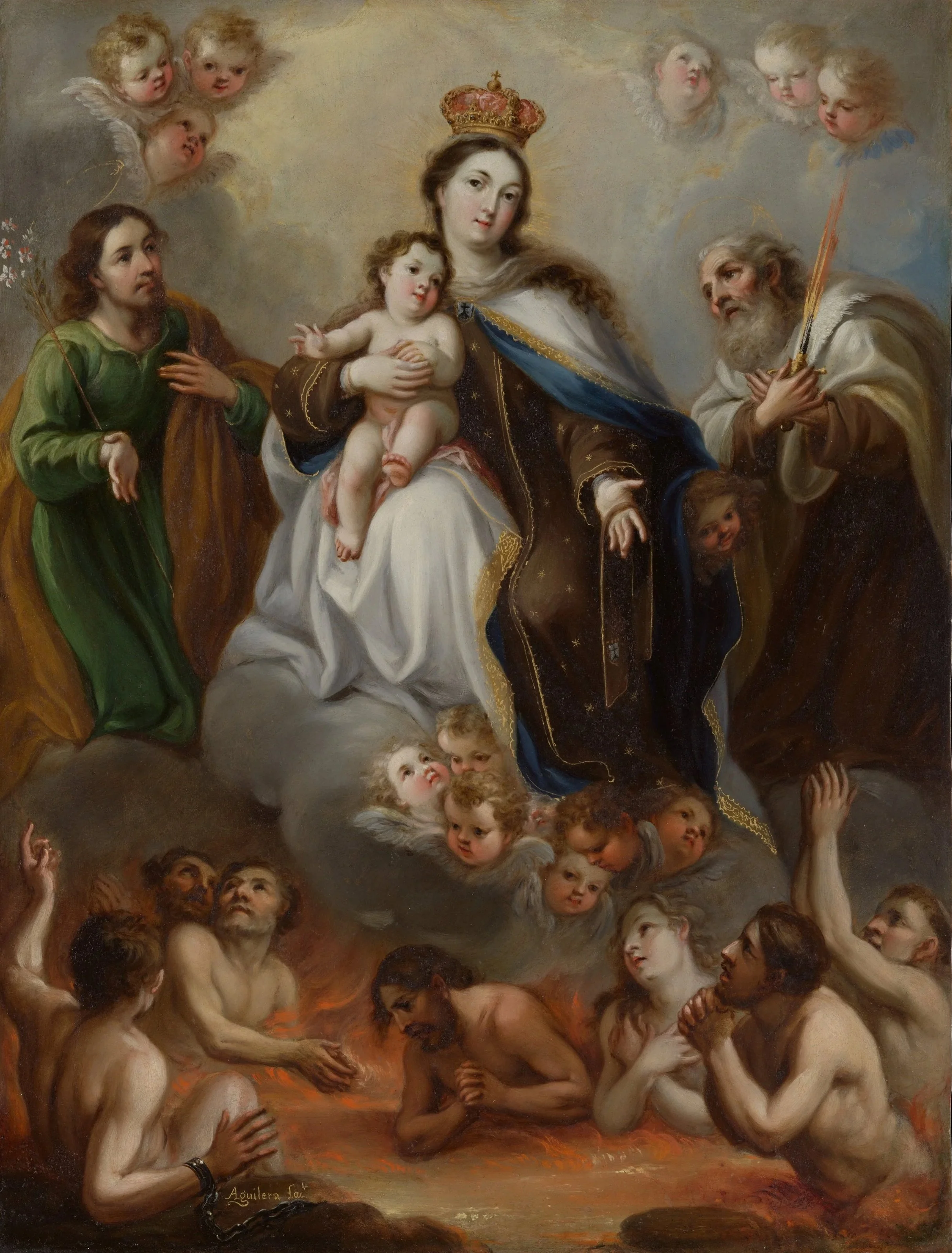
The Virgin of Mount Carmel and the Souls of Purgatory with St Joseph and the Prophet Elijah, Juan Francisco de Aguilera, c. 1720. The suffering souls look toward Heaven in hope, illustrating the Catholic doctrine that those in Purgatory are already saved and can be assisted by the prayers and suffrages of the Church.
What Is an Indulgence?
The Catechism of St Pius X defines an indulgence as the remission of temporal punishment due to sins whose guilt has already been forgiven. It teaches that the Church possesses this power from Jesus Christ and applies the spiritual treasures entrusted to her.
The 1917 Code of Canon Law, canon 911, expresses the same doctrine juridically: an indulgence is the remission before God of temporal punishment due for sins already forgiven as to guilt, granted by ecclesiastical authority from the treasury of the Church.
Three words are particularly important:
Already forgiven.
An indulgence
does not forgive mortal sin.
It does not replace contrition.
It does not replace sacramental absolution when Confession is required.
It does not give permission to sin.
It concerns the temporal punishment remaining after guilt has been remitted.
Partial and Plenary Indulgences
Traditional Catholic theology distinguishes:
A partial indulgence, which remits part of the temporal punishment due.
A plenary indulgence, which remits the whole temporal punishment then due, provided the indulgence is actually gained in its fullness according to the required conditions and dispositions.
The Church therefore never taught that merely possessing an indulgenced object, mechanically uttering a formula or paying money automatically erased sin.
The 1917 Code, canon 925, required the person gaining an indulgence to be baptized, not excommunicated, in the state of grace at least by the completion of the prescribed works, to have the necessary intention and actually to perform the works required.
What Is the Treasury of the Church?
This expression is easily misunderstood. The “treasury” is not a storehouse of imaginary spiritual currency. Its foundation is Jesus Christ Himself and the infinite value of His satisfaction and merits.
The Roman Catechism stresses that the satisfaction offered by Christ is complete and superabundant. Whatever satisfactory value exists in the works of Christians derives entirely from their union with Him.
Because Christians constitute one Mystical Body in Christ, the supernatural fruits of Christ's merits—and, subordinately and entirely through His grace, the superabundant satisfactions of the Blessed Virgin Mary and the saints—benefit the members of that Body.
St Thomas Aquinas (c. 1225–1274) explains in Summa Theologiae, Supplement, question 25, that indulgences operate through the power of the keys and the communion of the Church, with their efficacy rooted above all in the merits of Christ. (New Advent)
Thus the correct order is:
Christ's infinite satisfaction → communion in His Mystical Body → authority of the keys entrusted to the Church → remission of temporal punishment.
Nothing is being added to the sufficiency of the Cross. Rather, the Church is applying what Christ merited.
Can Indulgences Help the Dead?
Yes, when the indulgence is granted as applicable to the faithful departed.
There is an important theological distinction.
For a living subject, the Church exercises her authority directly in granting the indulgence.
For a departed soul, she applies the indulgence by way of suffrage—that is, by intercessory application before God rather than by exercising coercive jurisdiction over a deceased person.
Canon 911 of the 1917 Code made this distinction between indulgences applied to the living and suffrages for the departed. Canon 930 provided that papal indulgences were ordinarily applicable to souls in Purgatory unless otherwise stated.
St Thomas likewise discusses how indulgences may benefit the dead according to the form in which the Church grants them. (New Advent)
This belongs within the larger doctrine of the Communion of Saints: Christians on earth remain united in charity with those who have died in Christ.
What Did “40 Days” or “Seven Years” of Indulgence Mean?
This is another common misunderstanding. In older Catholic devotional books one may see expressions such as:
“an indulgence of 40 days”
or
“an indulgence of seven years.”
This did not mean that exactly 40 calendar days or seven chronological years would be removed from a person's stay in Purgatory. The terminology referred historically to the remission corresponding to the spiritual effect of a specified period of the ancient canonical penances formerly imposed by the Church.
The Baltimore Catechism expressly explains this point. An indulgence of forty days did not purport to reveal how long Purgatory lasts or to subtract forty days from a celestial timetable. (Intratext)
The duration of a particular soul's purification is not something the Church has given us a mathematical method of calculating.
Historical Abuses Versus Catholic Doctrine
There were abuses surrounding indulgences. That should neither be denied nor exaggerated.
By the beginning of the sixteenth century, preaching about indulgences could become entangled with fundraising, poorly instructed popular piety and scandalous financial practices. The strongest evidence is not Protestant polemic but the Catholic Church's own legislation.
At its final session in 1563, the Council of Trent taught that the use of indulgences was salutary and should be retained. Yet in the very same decree it ordered that abuses be corrected and, in particular, that corrupt financial profit associated with them be abolished. It also directed bishops to correct abuses arising from superstition, ignorance and irreverence.
That distinction is essential:
| Misconception or Abuse | Catholic Doctrine |
|---|---|
| “You can buy forgiveness.” | Forgiveness of guilt must already have taken place. An indulgence concerns temporal punishment. |
| “An indulgence gives permission to sin.” | It does nothing of the kind. Deliberately intending to persist in grave sin contradicts the dispositions required. |
| “Money automatically releases souls from Purgatory.” | The Church never defined salvation or forgiveness as a commercial transaction. |
| “Forty days means exactly forty fewer days in Purgatory.” | The older measurement referred to the equivalent value of ancient canonical penance. |
| “Because indulgences were abused, the doctrine must be false.” | The Council of Trent simultaneously condemned the abuses and reaffirmed the doctrine. |
The Baltimore Catechism likewise acknowledges that abuses had occurred and stresses that one must distinguish the abuse of indulgences from the doctrine itself. (Intratext)
It is therefore unnecessary to make the Catholic case depend upon disputed anecdotes about particular preachers or upon the exact authenticity of every slogan attributed to Johann Tetzel. The decisive historical fact is already documented by Trent: abuses existed, some involved corrupt gain, and the Church ordered their suppression while preserving the doctrine.
The Main Objection
A strong Protestant objection can be stated as follows:
Christ paid the whole price for sin on the Cross. If God has forgiven a Christian, there can be nothing left for him to suffer or satisfy. Purgatory therefore implies that Christ's sacrifice was insufficient. Indulgences make matters worse by suggesting that the Church can transfer merits or even sell relief from punishment. Moreover, 2 Machabees is not accepted as Scripture by Protestants, and the historical sale of indulgences helped provoke the Reformation.
That objection raises several distinct questions and deserves a distinct answer to each.
Response
Christ's Sacrifice Is Completely Sufficient
The Catholic doctrine begins—not ends—with the complete sufficiency of Calvary. The Roman Catechism describes Christ's satisfaction as superabundant. St Thomas makes Christ's merits the principal foundation of indulgences. Catholicism therefore does not teach:
Christ paid most of the debt → we complete the remainder ourselves.
It teaches:
Christ merited everything → Christ forgives → Christ sanctifies → Christ makes our penance meritorious → Christ completes the purification of His members. (Wikisource)
Scripture Distinguishes Forgiveness from Chastisement
David's case cannot simply be ignored. God explicitly forgave him, yet temporal punishment followed.
Likewise, Hebrews presents divine chastisement not as rejection by God but precisely as the discipline of sons whom He loves.
Consequently, “forgiven” and “no further purification or chastisement whatsoever” are not synonymous in Scripture.
Heaven Requires Perfect Holiness
Purgatory is ultimately about sanctification. If nothing defiled can enter Heaven and if a Christian dies in God's friendship while still imperfectly purified, Catholic doctrine does not conclude that God damns him.
Nor does it conclude that impurity simply becomes irrelevant at death. God finishes what His grace has begun.
Purgatory is therefore better understood as the victory of sanctifying grace, not as a rival to justification.
Prayer for the Dead Predates Medieval Catholicism
Catholics accept 2 Machabees as inspired Scripture, as the ancient Catholic Church did.
A Protestant who rejects its canonicity will naturally not accept it as inspired evidence. Yet that does not erase its historical significance: the text demonstrates prayer and sacrifice for the dead within Judaism before Christ.
More importantly, the practice appears unmistakably in the ancient Christian liturgy. Cyril of Jerusalem, Chrysostom and Augustine are evidence that prayers and Eucharistic offerings for departed Christians were not a medieval invention. (New Advent)
An Indulgence Does Not Sell Forgiveness
The doctrinal definition itself excludes that interpretation. An indulgence applies only to temporal punishment associated with sins already forgiven as to guilt.
Financial abuses can therefore be condemned precisely because they corrupt the proper spiritual use of indulgences rather than because Catholic doctrine itself teaches that grace can be bought.
Trent's action is particularly revealing: it did not choose between denying the abuses and abandoning indulgences. It did both things required by the evidence—condemned the abuses and retained the doctrine.
What We Can and Cannot Conclude
Established Catholic doctrine: Purgatory exists. Souls who die in God's friendship but require final purification are purified after death. The prayers and suffrages of the faithful assist them. Temporal punishment can remain after the guilt of sin has been forgiven. The Church possesses authority to grant indulgences.
Established Catholic doctrine: An indulgence concerns temporal punishment due to already-forgiven sin. It is not absolution from mortal sin, a license to sin or the purchase of salvation.
Established Catholic doctrine: The efficacy of satisfaction and indulgences ultimately derives from Christ's merits. Catholic teaching does not place the merits of the saints in competition with Christ.
Historical fact: Serious abuses became associated with indulgences. The Council of Trent expressly condemned corrupt financial gain and other abuses while reaffirming the legitimate use of indulgences.
Traditional theological teaching: Purgatory involves real suffering because purification and satisfaction are real. Latin theologians have commonly spoken of purgatorial fire.
Not defined with the same precision: The physical nature of that “fire,” the precise manner in which purgatorial punishment is experienced, the geographical “location” of Purgatory and a measurable earthly duration for an individual soul are not the substance of the dogma. Trent itself cautioned against presenting doubtful and subtle speculation to the faithful as though it were necessary doctrine.
What is not necessary to establish the doctrine: It is unnecessary to prove every allegation made about Tetzel, every medieval preacher or every disputed slogan surrounding the Reformation. Catholic doctrine must be judged by what the Church actually taught, while genuine abuses should be acknowledged wherever the historical evidence establishes them.
Conclusion
Purgatory follows from several truths that belong together.
God truly forgives sin. Yet Scripture shows that forgiveness does not always remove every temporal consequence of sin.
God requires perfect holiness for the vision of Himself, and nothing defiled enters the heavenly Jerusalem.
Scripture also records prayer and sacrifice for the dead, and the ancient Church continued that practice in her liturgy.
The progression is therefore:
sin → repentance and forgiveness → possible remaining temporal punishment and disorder → purification → perfect holiness → Heaven.
An indulgence belongs within that same economy of grace. It does not forgive an unrepented mortal sin and does not purchase salvation. It is the Church's remission of temporal punishment already remaining after guilt has been forgiven, drawing upon the treasury whose inexhaustible foundation is Jesus Christ and His merits.
Historical abuses do not need to be denied. Trent itself condemned them. But an abuse of a doctrine is not the doctrine itself.
The practical consequence is deeply Catholic. Christians should not presume upon God's mercy while neglecting penance. We should confess our sins sincerely, make satisfaction, accept suffering patiently, practise prayer and almsgiving, make worthy use of indulgences granted by the Church and, above all, pray and offer the Holy Sacrifice of the Mass for the faithful departed.
Death does not end Christian charity. Those who have died in Christ but still require purification remain members of His Mystical Body. To pray for them is therefore an act of faith, hope and supernatural charity—and a reminder that every Christian is ultimately called not merely to be forgiven, but to become perfectly holy in Christ.
Primary Sources
Sacred Scripture: 2 Machabees 12; 2 Kings 12:13–14; 1 Corinthians 3; Matthew 12; Hebrews 12:5–14; Apocalypse 21.
Council of Florence (1439), Decree for the Greeks: teaching on post-mortem purification and suffrages for the departed. Council of Florence — Decree for the Greeks
Council of Trent, Session VI (1547), Decree on Justification, Canon 30: temporal punishment may remain after guilt and eternal punishment have been remitted. Council of Trent — Session VI
Council of Trent, Session XXV (1563), Decree concerning Purgatory: existence of Purgatory and efficacy of suffrages, especially the Sacrifice of the Mass. Council of Trent — Decree on Purgatory
Council of Trent, Session XXV (1563), Decree concerning Indulgences: legitimacy of indulgences together with condemnation and reform of abuses. Council of Trent — Decree on Indulgences
Roman Catechism / Catechism of the Council of Trent, Part II, Sacrament of Penance: satisfaction, temporal punishment and the superabundant satisfaction of Christ. Roman Catechism — Penance and Satisfaction
Catechism of St Pius X, section on Indulgences: definition, authority, treasury, partial and plenary indulgences. Catechism of St Pius X — Indulgences
1917 Code of Canon Law, canons 911 and 925–930: definition, conditions and application of indulgences. 1917 Code — Indulgences
St Thomas Aquinas, Summa Theologiae, Supplement, q. 25, “Of Indulgences.” St Thomas Aquinas — Supplement q. 25
St Thomas Aquinas, Summa Theologiae, Supplement, q. 71, “Of the Suffrages for the Dead.” St Thomas Aquinas — Supplement q. 71
St Cyril of Jerusalem (c. AD 313–386), Catechetical Lecture 23 / Mystagogical Catechesis V, 9–10. St Cyril of Jerusalem — Catechetical Lecture 23
St John Chrysostom (c. AD 347–407), Homily 21 on the Acts of the Apostles. St John Chrysostom — Homily 21 on Acts
St Augustine of Hippo (AD 354–430), Confessions, IX.13. St Augustine — Confessions Book IX
Further Reading
Baltimore Catechism, Lesson 21, particularly its treatment of temporal punishment, indulgences, abuses and the older “days and years” terminology. Baltimore Catechism — Indulgences
Related Questions
What Happens to the Soul Immediately After Death?
What Are Heaven and Hell?
Why Do Catholics Pray for the Dead?
Why Do Catholics Offer Masses for the Dead?
What Is the Communion of Saints?
Why Do Catholics Confess Their Sins to a Priest?
What Is the Holy Sacrifice of the Mass?
Can Our Prayers and Good Works Merit Anything Before God?